
Report of the meeting with the Ambassador of Spain to Russia
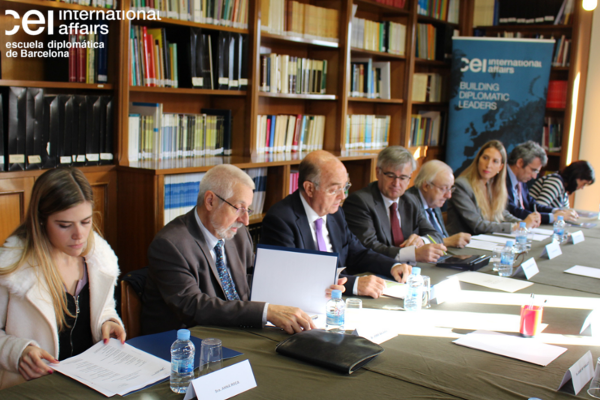
Within the framework of the activities of the International Classroom of CEI International Affairs, we had the opportunity to receive the Hon. Mr. Ignacio Ybáñez Rubio, Ambassador of Spain to Russia, who explained the current situation of the country and Russia’s relations with Spain, at a commercial and diplomatic level.
Ambassador Ybáñez began his dissertation analyzing a year that, for him, is essential to understand the current situation of Russia and its relations with the Member States of the European Union. This significant year was 2014 due to several factors:
- In the economic sphere, there was a 45% drop in oil prices, which, due to the fact that its export is the fundamental basis of the Russian economy, had a strong impact on it.
- In the political sphere, the crisis in Ukraine and the illegal annexation of Crimea provoked a strong coordinated response from the EU and the US, which did not hesitate to impose severe sanctions on the country in order to make the Eurasian giant change its attitude. These sanctions, among other measures, included the prohibition of arms trade with the country, the prohibition of exporting certain extraction materials, which was a blow to a State, already suffering from the low price of oil. However, the strongest element of these sanctions was the measures imposed with respect to the financial system, since these caused the Russian companies to stop having any relationship with European and American companies.
With this scenario of crisis, the country decided to adopt a series of countermeasures that affected, among other countries, Spain, when the export of agricultural products to Russia stopped. This year, 2014, marked the breaking of the trend of rapprochement that had been taking place in recent years between the EU and Russia.
As of this year, in 2015, for example, the Russian economy suffered a contraction of 2.8% and the ruble was strongly devalued. To avoid a major crisis, the government of President Putin decided to take measures of constriction, that is, to apply the so-called “economic orthodoxy”.
Regarding its foreign policy, as we have already seen, 2014 was a paradigm shift for the country. During the months before the political and diplomatic crisis between Russia and the EU, together with the US, the relationship was becoming increasingly cold, as there was a feeling that the Russian giant was radicalizing in its approach.
It was the decision of Ukraine to approach the EU, which provoked the irritation of a country that even demanded that Ukraine not sign any kind of agreement that supposed a rapprochement with the European organization. In this context, the country made the decision to invade Crimea, thus violating the laws of international law. In this situation, Russia decided to look for other allies in the region, especially among those states with which historically it has maintained a strong relationship, that is, with those of the orbit of the extinct Union of Soviet Socialist Republics (USSR), as they could be Belarus, Armenia, etc. However, other countries such as Georgia, Moldova, or Ukraine itself, began to strengthen their relations with the EU.
Another important aspect of its foreign policy is to create a new polarity, especially with the BRICS countries (Brazil, Russia, India, China and South Africa), and, within these, fundamentally with the Asian giant, China. Russia, in short, has reinforced its presence in other spheres of international relations, such as in the Middle East, where it wanted to play a leading and fundamental role in the Syrian crisis, or, also, in Latin American countries, like Mexico or Argentina. This new approach to its foreign policy is a response to the situation in which it was placed after the aforementioned events of 2014.
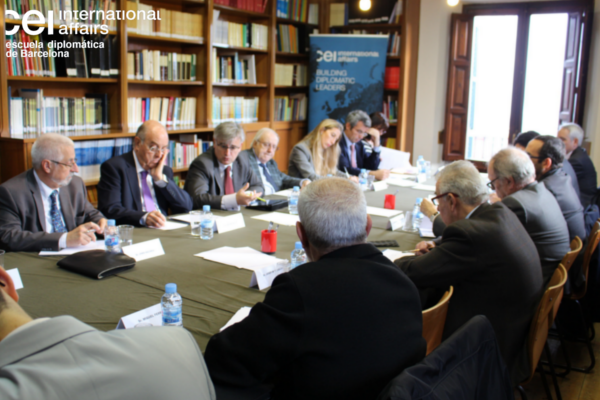
After this exposition of the situation by the Ambassador, different questions were asked, due to the high commercial and economic interest that the country presents:
- On the one hand, the fact that the EU did not know how to communicate well enough to Russia the true intentions of its neighborhood policy, but that in the current situation it is fundamental to strengthen the dialogue between the parties, which can be boosted by important figures such as Macron or Merkel. Regarding the question of Russian interference in the internal affairs of other states, these are not due to an ideological issue, but to a reaction against the EU, and it is stressed again that more work should be done on the positive side, i.e. in improving the means of communication, than in the negative, to prevent these types of attacks from occurring. It also revealed the growing interest in Spanish and Spanish culture, as well as agreements already made between some Spanish and Russian universities.
- On the other hand, debating about the Russian role in the Syrian War, it was stated that Russia presents its participation in it as a victory. From the beginning he cared about the movements of the Arab Spring. For Russia, their participation in the conflict has been a good investment, although now they only want the political negotiation to advance so that the withdrawal can be effective as soon as possible. Interestingly, it highlights that the military cooperation on the ground between the US and Russia has been absolute.
As a conclusion, we can see that Russia is in a new situation after that turning point marked in 2014, but has managed to adapt to it. In the commercial sphere, there are good business opportunities for Spain and its companies and, in short, Russia is “doomed” to dialogue with the EU to face the numerous global challenges that arise in this century.
Report prepared by José Javier Espinosa López
Student of the Preparation Course to Join the Diplomatic Corps